

- People are at the center of changing workplace trends, and the organizations who recognize them are the ones that will thrive.
- Human sustainability means recognizing workers as a whole person, not just a means to an end for work.
- Employees and executives have a disconnect when it comes to human sustainability, and it’s one leaders need to recognize and overcome.
We live in a boundaryless world.
What does that mean? And, more importantly, how does it impact work? It’s something Deloitte studied in its 2024 Global Human Capital Trends report.
Becoming boundaryless means recognizing the social constructs of offices, commutes, and the workplace watercooler are a thing of the past. Work impacts all aspects of our lives and looks significantly different than it did just four or five years ago.
How do we adjust to these recent changes and thrive in this new world of work? By placing importance back on the thing that hasn’t changed — the human worker.
In a recent webinar, Sue Cantrell, Vice President and U.S. Human Capital Eminence Leader at Deloitte, joined me to discuss the report’s major findings and why attention to human sustainability is essential for being successful.
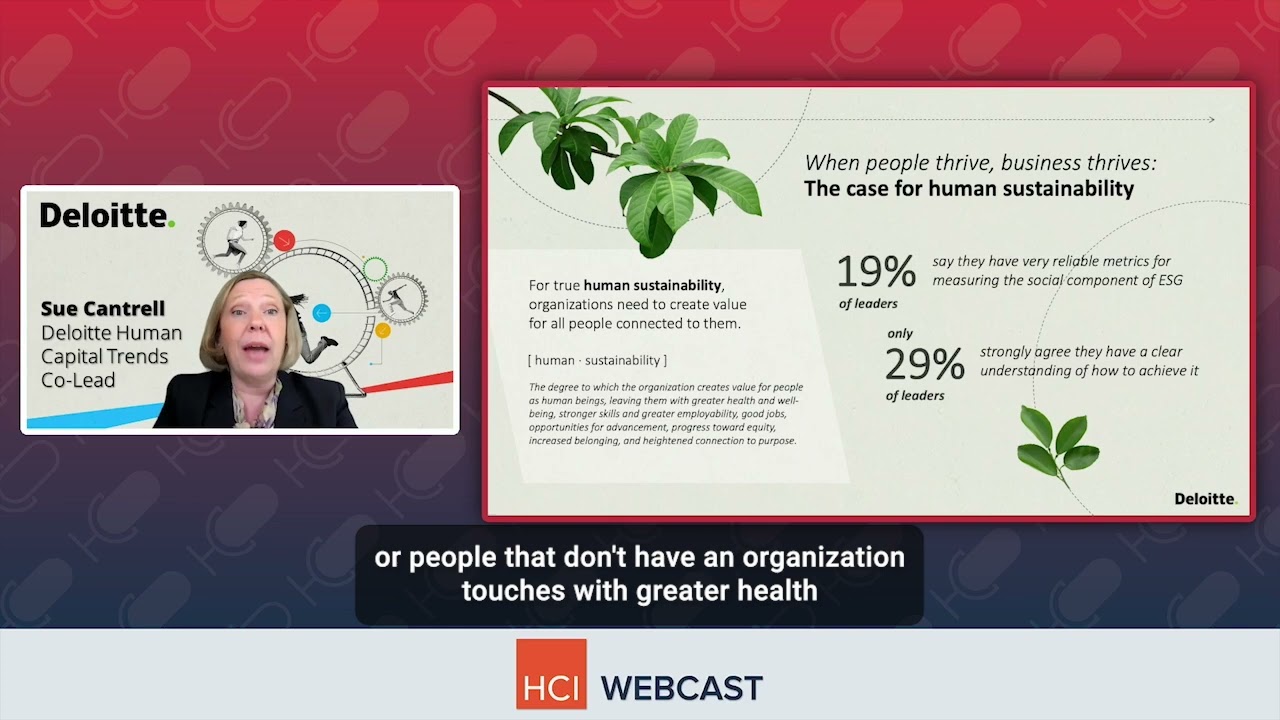
Sue Cantrell, Vice President and U.S. Human Capital Eminence Lead at Deloitte, joins Jason Cerrato, former Vice President of Market Strategy at Eightfold, to discuss human sustainability trends from Deloitte’s 2024 Global Human Capital Trends report.
What is human sustainability?
First, we need to understand what we mean when we say “human sustainability.” It is the degree to which an organization creates value for people as human beings, not just as workers.
For employees, this may include things like:
- Living equitable wages and long-term financial prosperity.
- Skills, employability, and advancement opportunities.
- Purpose and meaning.
- Equity and belonging as a result of diversity, inclusion, and addressing systemic causes of inequity and lack of belonging.
- Physical and psychological safety.
- Mental, physical, social, and financial well-being.
Human sustainability also includes extended workers — those who will enter the workforce soon or gig workers — as well as society as a whole.
“Employees are the central place where elevating purpose, meaning, physical and psychological safety, and skills and employability, but think about the organization’s relationship with broader society,” Cantrell said. “It can help improve population health, including environmental and climate impacts to health.
“It can help create good jobs for the economy with equitable and living wages. For example, it can have any kind of positive impact on communities or contributions to equity for populations that are historically marginalized because of race, gender, or other identities.”
Related content: Sue Cantrell, Vice President and U.S. Human Capital Eminence Lead at Deloitte, talks about the importance of addressing underlying structural and systemic issues when it comes to employee benefits.
Top challenges to human sustainability
There’s still a long way to go for most organizations to achieve quality human sustainability. According to the Deloitte report, only 43% of workers said they felt their organizations left them better off than when they started.
That’s more than half the workforce saying they’re not finding value in their work experiences.
Some of the top challenges identified in the report include:
- Increasing work stress leading to worse mental health.
- The threat of technology taking over jobs.
- The rising number of new skills and jobs needed as a result of technology or business model changes.
- Increasing risks of threats to physical safety or wellness in the workplace.
- The always-on economy, enabled by digital technologies.
- Employers being able to digitally monitor work without consent.
- Lack of connection and belonging due to remote or hybrid work.
An interesting disconnect between executives and workers was found when looking at top challenges: 89% of executives felt their organization was successfully advancing human sustainability while only 41% of workers agreed with that statement.
“Why this disconnect?” Cantrell said. “I think part of it is … we don’t have the right metrics to even get a sense as to how we are creating value for workers. Another reason is sometimes we believe executives believe that built-in programs or employee benefits — things like gym memberships, meditation, training, or volunteering — are enough to advance human sustainability.
“But our research suggests that it’s really about embedding it into work itself and addressing some of the underlying structural and systemic issues that get in the way of advancing human sustainability.”

Where does AI fit in?
This application of human sustainability beyond the immediate organization is where things like talent intelligence start to fit into the picture.
Why? Organizations using talent intelligence can better understand talent on a deeper level, making it easier to access those human performance outcomes. These organizations are also building more comprehensive platforms to expand the audience to a broader ecosystem of talent.
It’s also become more relevant in a boundaryless world. AI is allowing organizations to expand their reach and visibility into the entire ecosystem. This looks like expanding their audience to include partners, suppliers, the value chain, society, early career, and pipeline development. Doing so helps leaders understand talent on a deeper level.
At Eightfold, we point to companies like Amdocs whose leaders are using our platform to create a program called Harmony. Harmony’s goal is to better understand the needs, wants, and wishes of their talent. Employees can enter this data into the dynamic platform, so leaders can better understand needs from within their organization and see where their business is headed.
When you’re talking about sustainability, it requires a dynamic system that can react and evolve over time — that is exactly what our AI-native talent intelligence platform does.
6 ways to drive human sustainability
While being aware that human sustainability is important, taking action to work toward it — and do it well — is a step many organizations still need to take.
Here are six key things leaders can focus on:
- Create or focus on metrics that measure human outcomes.
- Tie leader and manager rewards to human-sustainability metrics.
- Involve workers, future workers, and others in co-creating their roles and human sustainability initiatives.
- Make the business case for human sustainability.
- Integrate human sustainability governance into the board and C-suite.
- Elevate managers’ human sustainability roles and empower them to own it.
“Sustainability requires this dynamic data to understand workers and their skills, and the dynamic ability to get at root causes, which can change over time,” Cantrell said. “We can’t necessarily always predict, but we can respond if we have data because human sustainability depends on us continuing to evolve and respond as things change.”
Watch the entire webinar How to create a thriving environment for people — and your business on demand now.
Jason Cerrato is former Vice President, Talent-centered Transformation at Eightfold AI. Before joining Eightfold, he was an HCM industry analyst with Gartner and held talent leadership positions at United Technologies for over a decade. Cerrato is the co-host of The New Talent Code podcast — new episodes streaming now.