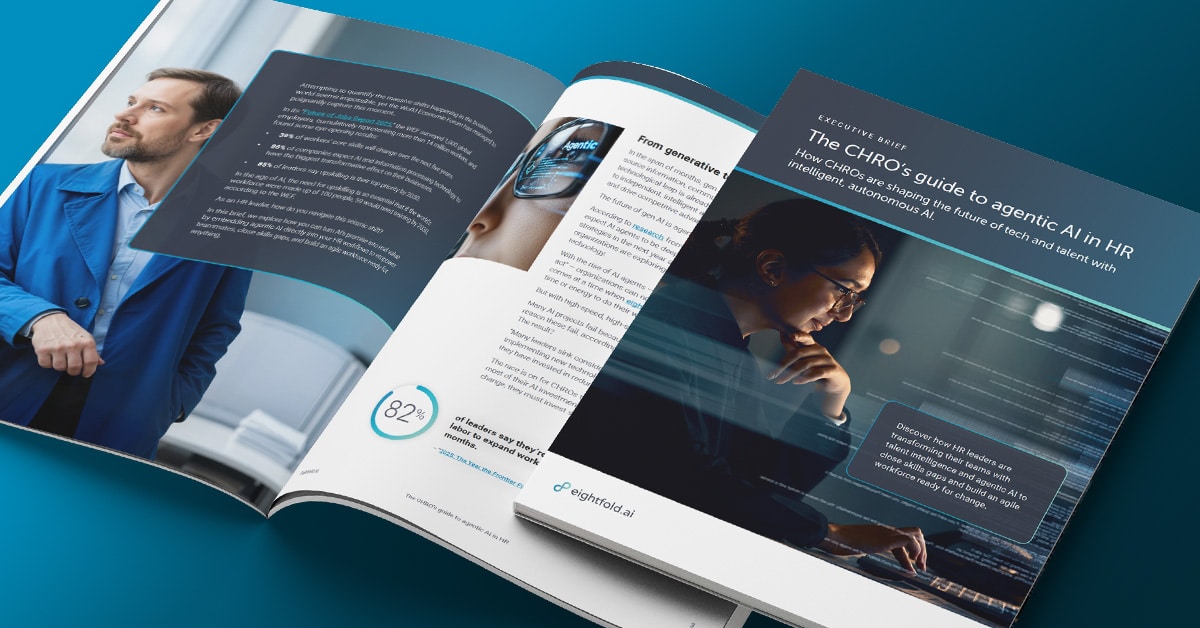

- The CHRO-CIO partnership acts as the primary differentiator for AI success. According to our latest survey, organizations with the most mature AI implementations and a clear partnership between people and technology functions have a distinct head start over those just beginning.
- The talent-tech connection remains essential for success. AI transformation fundamentally centers on people rather than just technology. Skills development, change management, and cultural adaptation require CHRO expertise. Currently, 64% of organizations cite AI skills gaps as their biggest transformation challenge.
- Leading organizations follow five distinct practices to build alignment, develop AI talent, establish governance, and prepare for AI-human collaboration. Following these practices results in three times more benefits compared to beginning organizations.
Here is a fascinating insight from our latest research. Eight out of 10 organizations beginning their AI journeys view CHROs as playing a minor role in transformation. Conversely, 90% of organizations leading in AI adoption and integration have discovered a different reality. A strong CHRO-CIO partnership remains absolutely essential to success. The difference in perspective goes beyond interesting observations. Collaboration between the top offices for people and tech transformation unlocks the full potential of AI across your organization. If your organization operates like most, you are navigating the complex journey of AI transformation to move beyond initial pilots toward enterprise-wide impact. Our latest survey, “AI transformation: The new role of the CHRO,” reveals exactly what works for organizations succeeding with AI initiatives and how involving your CHRO accelerates progress. Here are the major takeaways.

Understanding where most organizations are today
Our research of 700 organizations across North America, Europe, and Asia Pacific shows that AI transformation is well underway across various industries. We assessed organizations across seven foundational pillars, ranging from leadership alignment and governance to talent development and future-of-work planning. We then grouped these companies into three categories based on their maturity:
- AI beginners (21%) sit in the early stages of building an AI foundation.
- AI advancers (56%) have made starting or midway progress across key areas.
- AI leaders (24%) have achieved significant progress in creating the organizational, governance, and technological infrastructure needed for AI to scale.
The journey varies depending on where your organization stands in the process. Many leadership teams are currently working through internal alignment, with about two-thirds starting or midway through that critical step. Taking time for alignment makes sense because building consensus across diverse stakeholders requires intentional effort.

The opportunity to address human dynamics
AI transformation extends far beyond technology implementation. The most impactful challenges involve people and organizational culture. Among organizations in the middle of their AI journeys, 64% cite a lack of AI skills and knowledge as their biggest barrier to innovation. Meanwhile, 55% face staff resistance to change. These fundamentally human challenges present an exciting opportunity. Human dynamics represent the exact area where your CHRO makes the biggest difference, yet many organizations have not fully tapped into that potential.
] 
An untapped resource: The CHRO’s strategic potential
Organizations in the earlier stages of the AI journey possess a valuable opportunity to increase project success by involving their CHRO more strategically. Currently, about eight out of 10 AI beginners see CHROs playing a limited role. Furthermore, 57% report that technology or business units primarily drive these initiatives. Of those same organizations, only 7% report strong CHRO-C-suite collaboration. Just 1% currently view the CHRO-CIO partnership as essential. AI beginners can learn directly from AI leaders that have already discovered how powerful the HR and IT partnership becomes. Among organizations at early or intermediate maturity levels, only 10% have made significant progress in defining how the CHRO and CIO will work together. Just 5% have made significant progress in exploring collaborative working methods between these roles. Teams have significant room to grow in this area, with clear models ready to follow.
What AI leaders have discovered: The power of partnership
Our research identified an impressive 24% of organizations as AI leaders that have made significant progress in creating the organizational foundation for AI innovation. The secret behind their success lies in unlocking the potential of a strong CHRO-CIO partnership. The resulting outcomes speak volumes:
- 90% of leaders have found that AI transformation thrives with a strong CHRO-CIO partnership.
- 87% of leaders report the CHRO plays a vital role in building a culture of trust and transparency.
- 89% of leaders see the CHRO leading reskilling and upskilling efforts in response to AI-driven changes in roles and work processes.
The executive partnership actively transforms how work gets done. AI leaders report that CHROs and CIOs collaborate to empower people with AI, build AI-enabled workflows, provide enhanced experiences, drive responsible AI implementation, and co-create business strategies. “AI is transforming how we discover and develop strategies,” a CIO from a UK-based health care and life sciences company shared in our survey. “I view the CHRO as an important partner in this, ensuring our people are well-equipped, deeply engaged, and empowered to survive in an AI-first environment.” 
The AI Leader advantage: Unlocking organizational potential
Because AI leaders strategically engage CHROs in AI adoption and scaling, these organizations excel at navigating the human and logistical aspects of transformation. The advanced organizations consistently experience:
- 81 percentage points less concern about AI skills gaps.
- 41 percentage points less staff resistance to AI.
- 36 percentage points fewer challenges with organizational silos.
- 23 percentage points fewer issues with a lack of executive buy-in.
Your CHRO brings essential capabilities that perfectly complement technology leadership. As one CTO from a U.S.-based public sector organization stated in an interview for our research report: “The HR function has become more central to enterprise strategy and overall decision making.”
Different types of organizations are finding success in several ways
The path to AI leadership varies significantly across organization size, region, and industry.
- By size: Larger organizations move faster. Our data shows 40% of companies with 10,000 or more employees have reached leadership status. Organizations with over $10 billion in revenue also show the highest AI maturity scores. Larger budgets explain the access to resources, but the trend also means middle-market firms have clear role models to follow and ground to catch up.
- By region: North American organizations sit slightly ahead at 30% AI leaders. Europe follows at 18%, and APAC sits at 24%. The data highlights a strong opportunity for growth across all regions.
- By industry: Telecommunications (50% AI leaders) and technology (49%) pioneer the way, followed closely by banking and professional services.
Large enterprises implementing AI achieve impressive results. Specifically, 40% report greater market share and competitiveness, 62% cite improved customer satisfaction, and 66% experience higher staff loyalty. 
5 practices of pioneering leaders
AI leaders follow a clear playbook that any company can adopt. High-performing organizations focus on the following core areas:
1. Building a foundation for AI success
AI leaders start transformation directly from the top. Executives stay deeply involved in AI pilots. Companies provide training to build foundational AI knowledge and ethical awareness across the entire C-suite. These organizations establish cross-functional teams to collaboratively own AI initiatives and clearly define how CHROs and CIOs will work together. Tracking progress remains a strict priority. AI leaders keep management informed through regular updates, dashboards, and performance reports. Furthermore, companies measure executive teams based on AI-specific metrics tied to innovation, adoption, and impact. Currently, 50% of AI leaders equip management teams with the skills and vision to guide AI-powered organizations. We expect that figure to reach 66% in the next two years.
2. Create a rich pool of AI skills, talent, and knowledge
AI leaders comprehensively invest in developing AI talent and skills. These organizations establish centers of excellence, often collaborating directly with academic institutions and ecosystem partners. Additionally, an impressive 97% of AI leaders offer hands-on workshops and AI literacy training for non-technical staff. Another 98% provide specialized AI training tailored to different organizational roles. Sharing AI use cases helps everyone understand practical applications and possibilities, fostering a culture of continuous learning.
3. Establish strong governance and security
AI leaders build trust through comprehensive governance frameworks. The top organizations conduct layered technical, legal, and societal reviews of AI initiatives, paying special attention to high-risk projects. Teams ensure compliance with emerging regulations like the EU AI Act and GDPR while embedding ethical principles into design workflows from the very beginning. Taking a thoughtful approach pays significant dividends. Only 2% of AI leaders report that regulations create conflicting views among leadership. Just 16% feel that compliance requirements limit innovation, proving that strong governance actually enables faster progress.
4. Focus on the future of work
AI leaders actively prepare for an evolved workplace. An impressive 81% of leaders recognize that the boundary between digital and human workers is shifting as AI agents take on more tasks. Similarly, 86% see the CHRO taking on expanded responsibility to orchestrate both human and digital workers. More than half of AI leaders have already made significant progress in developing plans to manage AI agents and creating digital workspaces where AI and humans collaborate effectively. Advanced organizations create long-term HR plans aligned with AI transformation, shifting talent teams to anticipate future needs and thoughtfully assessing how AI advances shape daily work.
5. Turn AI into a force multiplier
The payoff for getting AI transformation right is substantial. As organizations progress from early stages to leadership, the benefits from AI innovation increase threefold. AI beginners see an average of 3.42 benefits, while AI leaders experience more than 11 distinct benefits. The performance improvements across the business are remarkable:
- AI leaders are 14.7 times more likely to see higher staff productivity.
- AI leaders are 13 times more likely to see higher shareholder value.
- AI leaders are 5.6 times more likely to see higher profitability.
- AI leaders are 4.4 times more likely to experience greater revenue growth.
Your AI investments can drive innovation, boost customer satisfaction, increase scalability and agility, accelerate time to market, and create entirely new business models. The evidence clearly shows what becomes possible when you build the right structural foundation.
Your opportunity: Elevating the CHRO’s role
The evidence remains clear: technology transformation and people transformation work best when orchestrated together. AI transformation requires skills development, change management, and breaking down departmental silos. CHROs naturally excel in all of these critical areas. Here is how to accelerate your company’s progress:
- Elevate the CHRO as a strategic partner in AI transformation. Give your CHRO a seat at the strategy table with meaningful budget authority. Recognize that people transformation and technology transformation represent two sides of the same coin.
- Strengthen the CHRO-CIO partnership. Make cross-departmental collaboration a strategic priority with joint OKRs and regular alignment meetings. Only 10% of organizations at early stages have made significant progress here, while 65% of AI leaders have achieved this critical foundation.
- Build the organizational foundation for sustained AI success. Many organizations currently work through implementation across key initiatives. Now is the perfect time to shift from limited pilots to enterprise-wide deployment. Build specialized AI capabilities, forge external partnerships, and create accountability with AI-specific executive metrics.
The path forward is clear
Organizations across every industry and region are discovering exactly how to make AI transformation work. AI leaders do not just invest in technology. These advanced organizations invest heavily in building the partnership between technology and people leadership. The playbook for success is becoming highly visible. AI leaders have found that CHRO-CIO partnerships, comprehensive skills development, strong governance, future-of-work planning, and strategic execution create remarkable results. These combined efforts drive higher productivity, greater innovation, improved customer satisfaction, and significant competitive advantages. You have an incredible opportunity ahead. By recognizing the CHRO as a strategic partner in AI transformation rather than just a supporting function, you can accelerate your progress and unlock the full potential of AI for your organization. For more findings, download the full survey, “AI transformation: The new role of the CHRO.”